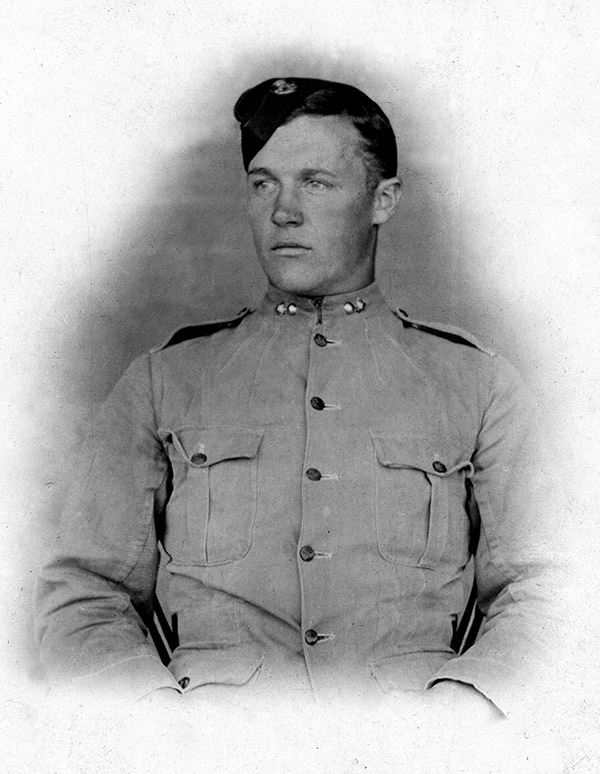
IT becomes obvious from Thord’s record of his role in the Anglo-Boer conflict that he thrived on war. He had jumped ship in Cape Town on Boxing Day 1895 with a shilling and sixpence in his pocket. He worked for 16 hours a day – for 20 shillings a month – on the farm of a Danish settler, then set out for Kimberley after the farmer refused to pay him his hard-earned slave wages. Thord survived on venison shot with a revolver gifted him by the farmer’s wife. He was persuaded to turn back to Cape Town by another Dane, a station master near Touw’s River.
By the time Britain declared war on the Boers in October 1899, he had enlisted with the Cape Mounted Riflemen. ‘War seems an enjoyable pastime,’ he wrote to his brother Gunnar on 3 January 1900. ‘So far there has been no fear in the Swedish blood.’
Thord gives a graphic account of his part in the defence of Wepener. ‘I feel in good humour,’ he wrote to his father on the latter’s sixtieth birthday, 10 April 1900. ‘Many cannot face the terror of war… but I like it.’ On his own twenty-second birthday one week later he wrote that the hospital quarter was full of wounded – ‘there is nothing to bandage the poor fellows with, and no instruments to carry out surgery’.
‘I myself feel as sound as a bell,’ he wrote on 24 April 1900. ‘It must be the Swedish blood, which now shows what it is. It is true that many a night I have felt dead exhausted. But after only a few hours’ sleep the Swedish warrior gets up healthy, as if nothing had happened.’